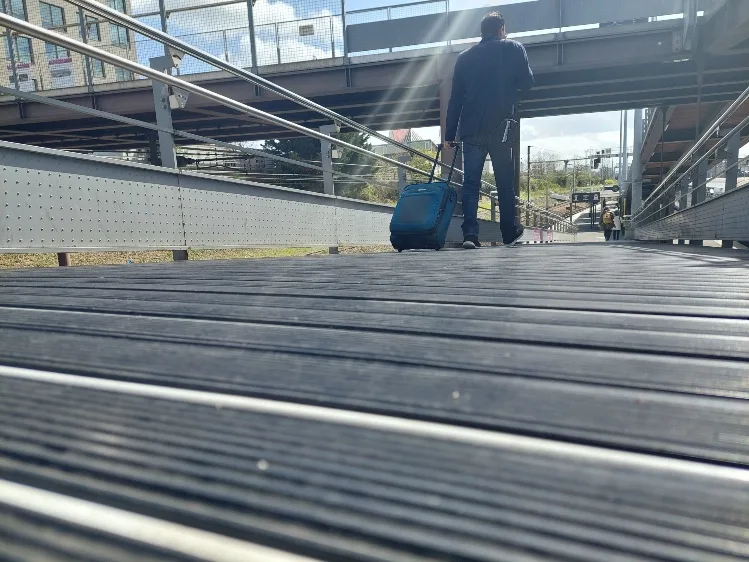
At busy stations, wooden decking deteriorates within 7 to 8 years, necessitating costly replacements and posing a risk of slipping and electric arcing near the catenary wires. BORFLEX has designed RUBBY, a complete decking system (joists and battens) made from composite materials and rubber – including recycled rubber sourced via VALUE RUBBER – which has been installed over an area of 1,800 m² at Saint-Denis station – Stade de France in 2024
ISSUE
- With passenger numbers reaching up to 25,000 a day, traditional wooden decking begins to deteriorate after just 7 to 8 years of use, necessitating frequent replacement programmes, each of which requires work to be carried out at the station, with an impact on passenger flow and the maintenance budget
- In busy pedestrian areas, slipping on wet or worn surfaces is a recurring risk of accidents involving pedestrians, with liability implications for the operator
- The presence of overhead catenary wires creates a risk of electric arcing, which the flooring must help to prevent; unsuitable flooring increases the risk to people and to the infrastructure
- Platform and station layouts vary from one site to another: decking with fixed dimensions cannot be fitted without complex cut-outs or compromises in terms of fit, which prolongs the installation process and detracts from the visual result
BORFLEX SOLUTIONS
- Complete RUBBY system (structural joists + tread slats) made from composite and rubber, designed to withstand even the heaviest footfall over the long term, far exceeding the lifespan of traditional timber
- A non-slip formulation that reduces the risk of slipping in high-traffic areas, even in wet conditions
- Integrated electrical insulation that interrupts electric arc paths near overhead lines, providing a safety feature directly linked to the railway environment
- Slats of adjustable dimensions, allowing them to be tailored to the actual layout of each station
- Incorporation of recycled rubber through the VALUE RUBBER programme, ensuring the product forms part of an environmentally responsible approach consistent with the Group’s materials policy
- Installation of 1,800 m² at Saint-Denis – Stade de France station in 2024,
WHAT IT HAS ACHIEVED
By breaking new ground, RUBBY automatically eliminates the 7–8-year replacement cycle that places a strain on the maintenance budgets of busy stations. Every replacement programme avoided means one less construction project in the passenger area and uninterrupted service. The non-slip formulation and integrated electrical insulation address two distinct risks in a single product: slipping and electric arcing – risks that the wooden flooring did not naturally cover.
The modular joist-and-batten format allows the system to adapt to the architectural layout of each site without the complex cutting or fitting compromises imposed by standard slabs, which speeds up installation and improves the visual result. Furthermore, the incorporation of recycled rubber via VALUE RUBBER aligns the product with the Group’s materials policy, which is important for a railway contractor subject to increasing CSR requirements.